
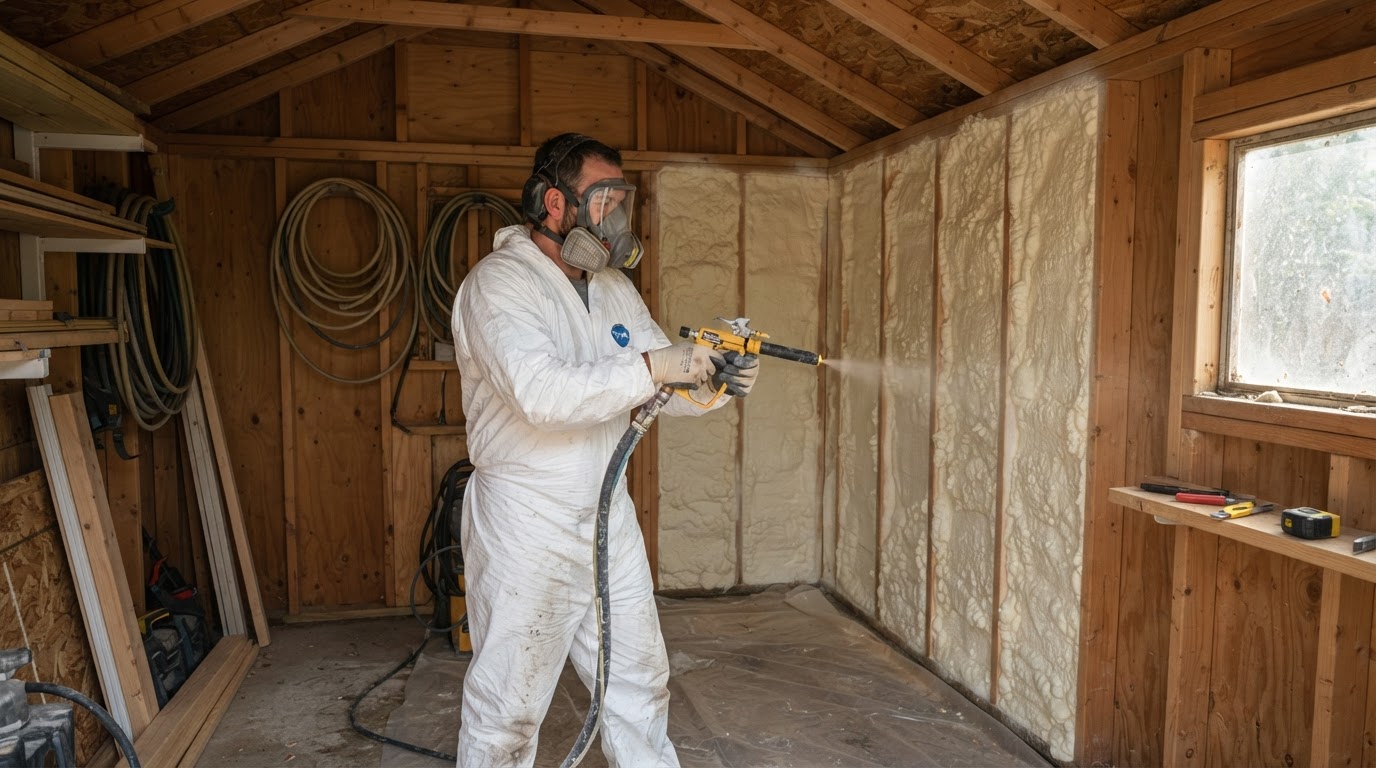
Shed & Outbuilding Spray Foam Insulation in Wilmington, NC
Air sealing and thermal-envelope support for storage sheds, utility buildings, backyard workshops, and small metal or wood-framed outbuildings across the Wilmington area.
How Spray Foam Insulation Works in Wilmington Sheds and Outbuildings
Shed and outbuilding spray foam insulation is applied to the rooflines, walls, and framing of smaller detached structures. The foam expands to fill cavities and conform to irregular gaps, providing insulation combined with air-sealing coverage across the small building envelope. Both wood-framed and metal outbuildings can be candidates depending on the assembly and substrate condition.
The usefulness of insulation in a shed or outbuilding depends heavily on how the structure is used. Basic lawn-equipment storage may have very different goals from a conditioned backyard workshop, a garden building, or a small equipment building. An unconditioned storage shed may not benefit from the same insulation strategy as a space that is heated, cooled, or used for long stretches of hands-on work.
Both new and existing outbuildings can be candidates where access and assembly conditions allow. In new buildings, foam is applied before finishes close the framing. In existing structures, access and existing conditions are evaluated first. A project-specific evaluation determines the appropriate application areas and product rather than assuming one method fits every Wilmington outbuilding.
Outbuildings That May Benefit From Spray Foam Near Wilmington
Wilmington's hot summers and coastal humidity place real demands on small detached structures, especially when they are used as workshops or conditioned spaces. Spray foam, when properly specified and installed, can help reduce uncontrolled air leakage, support thermal-envelope continuity, and provide coverage around irregular framing. The benefits depend on how the outbuilding is used.
Storage Sheds
Storage structures can benefit from improved envelope performance and air sealing.
Backyard Workshops
Backyard workshops benefit from more stable temperatures and air sealing for comfort and usability.
Utility Buildings
Utility buildings can benefit from air sealing and more manageable interior conditions.
Equipment Buildings
Small equipment buildings can benefit from improved envelope performance.
Garden Buildings
Garden buildings can benefit from reduced air leakage and more consistent conditions.
Small Metal Buildings
Closed-cell is often considered for small metal buildings where condensation is a concern.
Insulation alone does not control humidity to an exact level. In small outbuildings, ventilation, building use, and whether the space is conditioned all influence interior conditions. For owners considering a workshop conversion, spray foam can be part of a broader plan to make a backyard building more usable year-round.
Open-Cell vs. Closed-Cell Spray Foam for Sheds and Outbuildings
Neither open-cell nor closed-cell spray foam is universally correct for every shed or outbuilding. Product selection depends on whether the structure is wood or metal, the building use, roof and wall design, whether the space is conditioned, and the application goals. The comparison below is a general overview, not a project-specific recommendation.
Open-Cell in Outbuildings
- Lower-density foam that expands to fill irregular framing cavities
- Air-sealing function that can help reduce uncontrolled air leakage
- Sound-dampening characteristics that may be useful in backyard workshops
- Often considered for interior framed walls and rooflines in wood-framed outbuildings
Closed-Cell in Outbuildings
- Higher density and rigidity relative to open-cell
- Lower vapor permeance, useful in small metal buildings where condensation is a concern
- Often considered for metal walls and roofs
- May be part of a properly designed condensation-control strategy
Not sure which spray foam fits your project?
Call (910) 909-4411Shed and Outbuilding Spray Foam Installation Near Wilmington
A shed or outbuilding spray foam project accounts for the building use, structure type, and any contents that need protection. Because outbuildings often house tools, equipment, or stored items, access and preparation are planned carefully before application begins.
1. Building Use Discussion
We review the outbuilding type, intended use, and the areas being considered for insulation.
2. Structure Review
Framing, metal or wood surfaces, and roof design are evaluated on site before any recommendation.
3. Surface Determination
The appropriate surfaces for application are determined based on the assembly and project objectives.
4. Foam & Application Plan
Open-cell, closed-cell, or another appropriate approach is considered based on the structure and goals.
5. Contents Protection & Preparation
Stored contents and surfaces are protected and the work area is prepared with safe application conditions.
6. Installation & Final Review
Spray foam is applied to the planned surfaces and completed work is reviewed with the property owner.
Related Spray Foam Services
Want to talk it through first?
Shed & Outbuilding Spray Foam Insulation FAQs
Have a Shed or Outbuilding You Want to Insulate?
Whether you are insulating a storage shed, a backyard workshop, a utility building, or a small metal outbuilding, we can help plan the right spray foam approach. Property owners are welcome to discuss their project.