
Cathedral & Vaulted Ceiling Spray Foam Insulation in Wilmington, NC
Air sealing and thermal-envelope support for cathedral ceilings, vaulted ceilings, and sloped roof assemblies across the Wilmington area.
How Spray Foam Insulation Works in Cathedral and Vaulted Ceilings
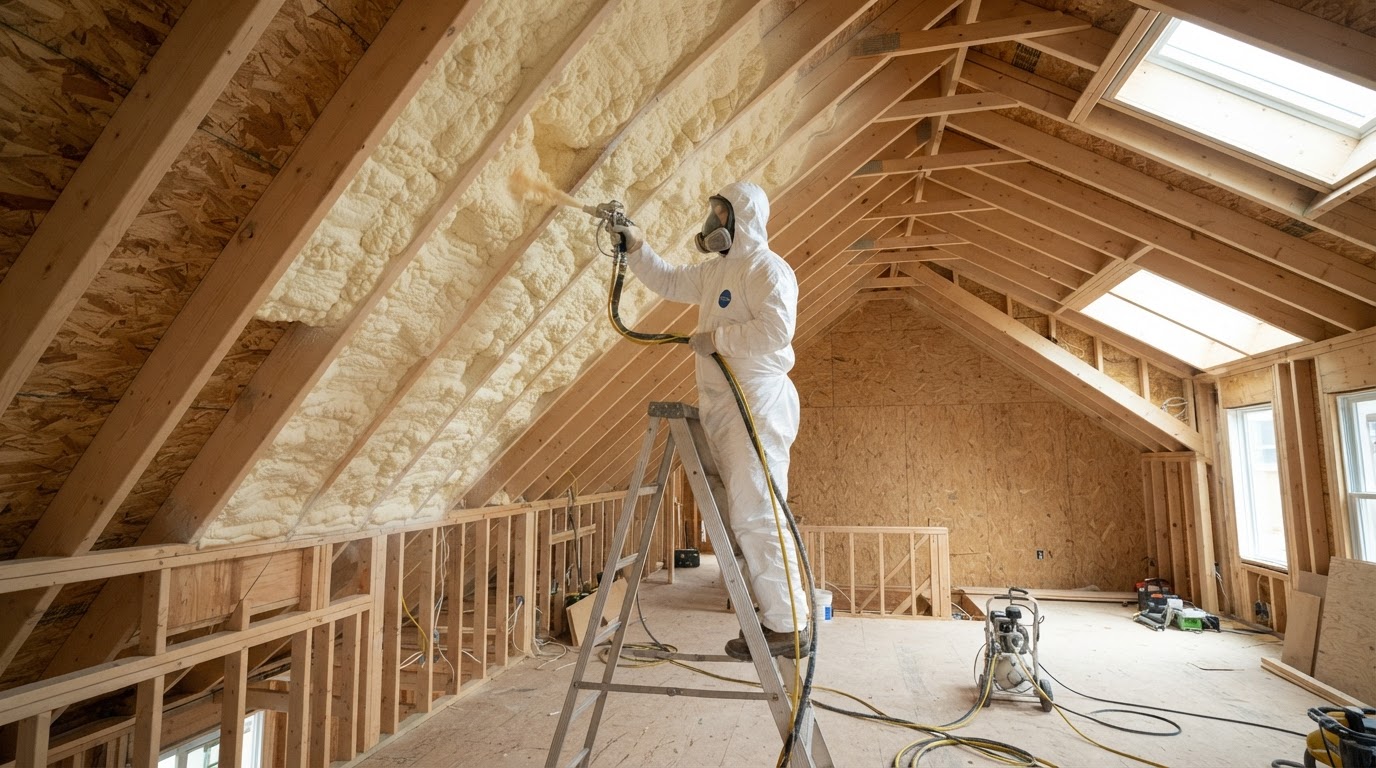
Cathedral and vaulted ceilings are sloped ceiling assemblies that follow the roof framing above, leaving limited or no attic space between the ceiling and the roof deck. Spray foam can be applied between rafters and to the roof sheathing where the assembly supports it, expanding to fill rafter bays and create a continuous layer of insulation combined with air sealing along the sloped roof assembly.
Roof assemblies vary widely. Some vaulted ceilings are designed as vented assemblies, others as unvented assemblies, and the appropriate insulation approach depends on the roof design, ventilation strategy, vapor-control plan, roofing design, local code requirements, and existing conditions. Spray foam is not always applied directly to roof sheathing in every assembly — the approach is project-specific.
Both new construction and renovations can be candidates where rafter bays and roof framing are accessible. In new construction, coordinating insulation before the ceiling finish is installed can make application more straightforward. A project-specific evaluation determines the appropriate application areas and product for your vaulted or cathedral ceiling.
Why Wilmington Homeowners Consider Spray Foam for Vaulted Ceilings
Vaulted and cathedral ceilings often have limited cavity depth and a direct relationship to the roof assembly, which makes air leakage and thermal-envelope continuity especially relevant. Wilmington's hot, humid summers place real demands on sloped roof assemblies. Spray foam, when properly specified and installed, can help reduce uncontrolled air leakage and support thermal continuity in complex framing.
Great Rooms
Open great rooms with vaulted ceilings benefit from air sealing at the roofline.
Primary Bedrooms
Vaulted primary bedrooms can benefit from more consistent conditions.
Living Rooms
Cathedral living rooms benefit from thermal-envelope continuity.
Home Additions
Additions with vaulted ceilings can be insulated as part of the envelope strategy.
Bonus Rooms
Bonus rooms with sloped ceilings benefit from rafter-bay air sealing.
Loft Spaces
Open loft areas with vaulted framing can benefit from roofline insulation.
Spray foam does not repair roof leaks. Active roof leaks, plumbing leaks, or bulk-water intrusion must be addressed before insulation is applied. A vaulted-ceiling insulation strategy should account for the roof assembly, ventilation strategy, and vapor-control plan rather than assuming one universal approach fits every sloped ceiling.
Open-Cell vs. Closed-Cell Spray Foam for Wilmington Vaulted Ceilings
Neither open-cell nor closed-cell is universally best for a vaulted or cathedral ceiling. Product choice depends on the roof assembly, cavity dimensions, vapor-control strategy, design goals, access, existing conditions, and building code. Both products can have a role depending on the assembly.
Open-Cell in Vaulted Ceilings
- Lower-density foam that expands significantly to fill rafter bays
- Air-sealing function that can help reduce uncontrolled air leakage at the roofline
- Sound-dampening characteristics that may be useful in occupied vaulted spaces
- Often considered for interior framed and roofline applications where a vapor barrier is not the primary objective
Closed-Cell in Vaulted Ceilings
- Higher density and rigidity relative to open-cell
- Lower vapor permeance, useful in moisture-sensitive roof assemblies where appropriate
- May be considered where the roof assembly supports a vapor-retarding strategy
- Common in select roof-deck and cathedral-ceiling applications where the assembly supports it
Not sure which spray foam fits your project?
Call (910) 909-4411Vaulted Ceiling Spray Foam Installation Near Wilmington: What to Expect
A vaulted or cathedral ceiling spray foam project starts with reviewing the ceiling and roof assembly and identifying accessible framing. Because these are sloped assemblies tied directly to the roof, the roof condition and ventilation strategy are evaluated before any recommendation.
1. Ceiling & Roof Assembly Review
We review the vaulted or cathedral ceiling assembly, roof design, and ventilation strategy.
2. Accessible Framing Identification
Accessible rafter bays and roof framing are identified, distinguishing new construction from retrofit access.
3. New Construction vs Retrofit
We discuss whether the project is new construction or a retrofit, which affects access and approach.
4. Project Limitations Evaluation
Existing conditions, roof condition, and any limitations are evaluated before a recommendation.
5. Application Strategy & Preparation
An application strategy is chosen and surrounding surfaces are prepared with safe application conditions.
6. Installation & Final Review
Spray foam is applied to the planned rafter bays and completed work is reviewed with the property owner.
Cathedral & Vaulted Ceiling Spray Foam Insulation FAQs
Planning a Vaulted or Cathedral Ceiling Project in Wilmington?
Whether you are building a new vaulted ceiling, retrofitting an existing one, or planning insulation for a cathedral ceiling or great room, we can help plan the right spray foam approach. Property owners and builders are welcome to discuss their project.