New Construction Spray Foam Insulation in Wilmington, NC
Pre-drywall insulation and air-sealing planning for new homes, additions, and commercial builds across the Wilmington area.
Spray Foam Insulation for New Construction Near Wilmington
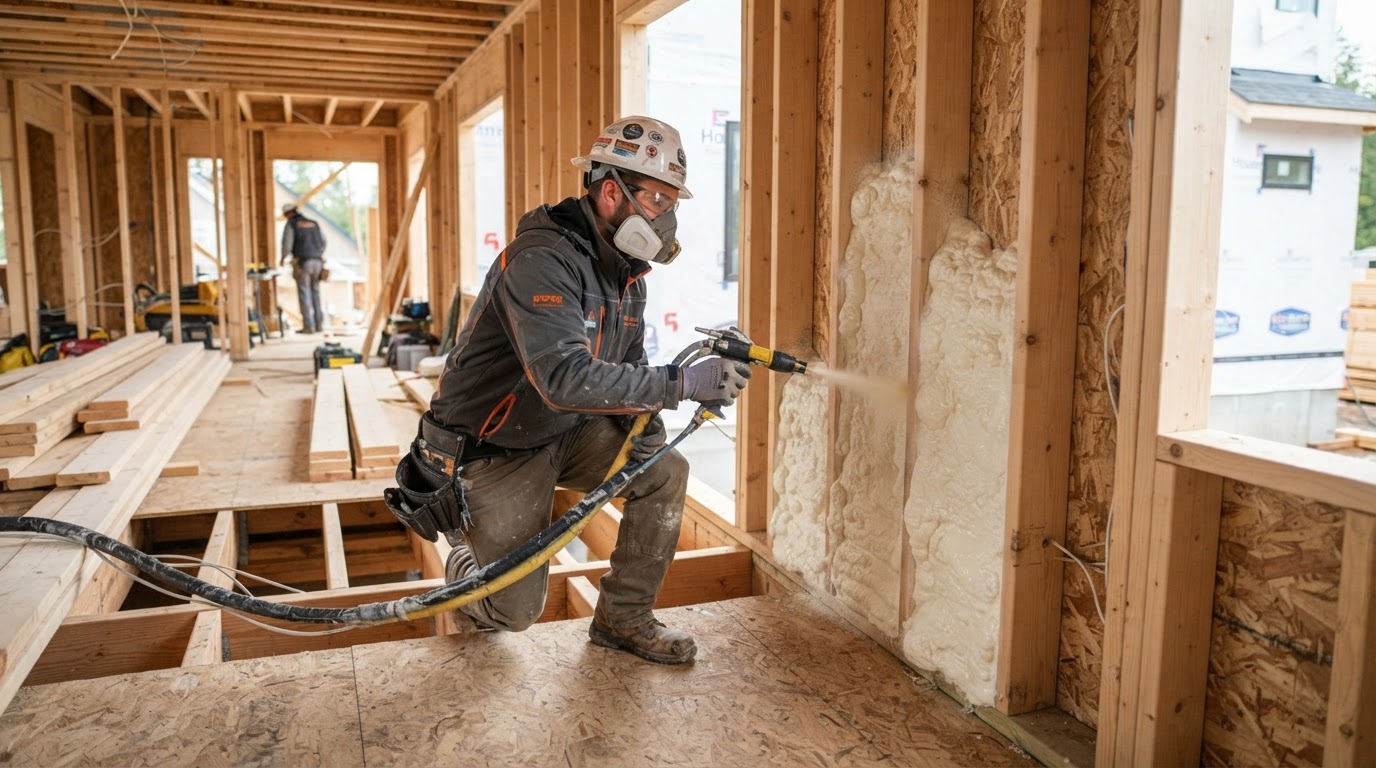
New construction spray foam insulation is planned and installed while framing is still accessible, before drywall and interior finishes close the wall cavities, attic, and roofline. Because the assemblies are open, spray foam can be applied to exterior wall assemblies, attics, rooflines, roof decks, crawl spaces, garage assemblies, and commercial structures in a coordinated sequence that matches the build schedule.
Planning insulation during construction can be advantageous because the building envelope is fully accessible. A coordinated air-sealing strategy can be developed before finishes are installed, and foam can be applied to framing cavities, transitions, and hard-to-reach areas that would be difficult to address after drywall. This does not require a specific engineering sequence, but it does benefit from early coordination between the builder, trades, and insulation contractor.
Both open-cell and closed-cell spray foam are options for new construction, and different foam types may be used in different assemblies depending on design, location, vapor control, budget, performance goals, and code requirements. A project-specific evaluation helps determine where each product fits within the overall building-envelope plan.
Benefits of New Construction Spray Foam for Wilmington Properties
Wilmington's hot, humid summers and coastal climate place real demands on new building envelopes. Spray foam, when properly specified and installed, can help reduce uncontrolled air leakage, support thermal-envelope continuity, and cover difficult framing transitions. The benefits depend on the assembly and the extent of coverage planned.
Air-Sealing Continuity
A coordinated air-sealing strategy can be developed before finishes are installed.
Cavity Coverage
Expanding foam fills framing cavities and transitions that are difficult to insulate with batts.
Envelope Planning
Thermal-envelope planning during construction can support comfort and efficiency goals.
Roofline Options
Roofline applications can bring ductwork and equipment into a conditioned envelope, depending on design.
Coastal Climate Fit
Humidity and temperature swings are part of southeastern NC building conditions; envelope planning should account for them.
Comfort Support
Reducing uncontrolled air leakage may improve comfort, depending on the assembly and coverage.
New construction project types around Wilmington include custom homes, production homes, home additions, commercial buildings, garages, metal buildings, and pole barns. Each project type has different envelope considerations, and a project-specific evaluation helps identify appropriate application areas.
Where New Construction Spray Foam Is Applied
Because framing is accessible during construction, spray foam can be applied across multiple building assemblies in a coordinated sequence. The applications below are common in Wilmington-area new construction, though not every build uses foam in every area listed.
Exterior Wall Assemblies
Open wall cavities are insulated and air-sealed before drywall is installed.
Attics & Rooflines
Roof deck and roofline applications can bring mechanical equipment into a conditioned envelope.
Crawl Spaces
Under-floor assemblies and rim joist areas are insulated while the framing is accessible.
Garage Assemblies
Attached and detached garage walls and rooflines are insulated during the build.
Commercial Structures
Warehouses, offices, and metal commercial buildings are insulated before finishes proceed.
Home Additions
Additions are insulated with spray foam where framing is accessible during construction.
What Should Be Evaluated Before New Construction Spray Foam
New construction allows insulation planning before finishes limit access, but several project-specific factors should be reviewed so the right product is applied to the right assembly.
- Framing stage and build schedule coordination
- Planned application areas — walls, attic, roofline, crawl space, garage
- Building-envelope design and air-sealing strategy
- HVAC layout and mechanical equipment location
- Vapor-control requirements for each assembly
- Combustion air and ventilation requirements
- Interior finish requirements and applicable code considerations
- Budget and performance goals
- Open-cell vs. closed-cell suitability for each assembly
- Trade sequencing with builder and other contractors
New Construction Spray Foam Installation Near Wilmington
A new construction spray foam project benefits from early coordination. Because insulation is installed while framing is accessible, timing and sequencing are planned with the builder so the work fits the construction schedule rather than disrupting it.
1. Project Discussion
We review the planned build, application areas, and insulation goals with the homeowner or builder.
2. Application Area Review
Planned wall, attic, roofline, crawl space, and garage assemblies are reviewed before any recommendation.
3. Timing Coordination
Project timing is coordinated with the build schedule so insulation fits before finishes proceed.
4. Preparation
Accessible assemblies are prepared and safe application conditions are established.
5. Application
Spray foam is applied to the planned assemblies following the agreed scope.
6. Pre-Finish Review
Completed areas are reviewed before drywall and interior finishes proceed.
Open-Cell vs. Closed-Cell Spray Foam in New Construction
New construction may use different foam types in different assemblies depending on design, location, vapor control, budget, performance goals, and code requirements. Neither product is universally correct. The comparison below is a general overview, not a project-specific recommendation.
Open-Cell in New Construction
- Lower-density foam that expands to fill irregular framing cavities
- Air-sealing function that can help reduce uncontrolled air leakage
- Often considered for interior wall and attic applications where appropriate
- Sound-dampening characteristics that may be useful in occupied spaces
Commonly considered for interior applications where a vapor barrier is not the primary objective.
Closed-Cell in New Construction
- Higher density and rigidity relative to open-cell
- Lower vapor permeance, useful in moisture-sensitive assemblies
- Often considered for crawl spaces, metal buildings, and roof decks
- May be part of a properly designed condensation-control strategy
Frequently selected for crawl spaces, metal structures, and moisture-sensitive assemblies.
New Construction Building Considerations in Wilmington, NC
New builds combine framing, mechanical systems, and finish sequencing that all interact with the insulation plan. The factors below are commonly reviewed when planning new construction spray foam in the Wilmington area.
Framing Stage
Spray foam is installed after framing and rough-in are complete but before drywall closes the cavities.
HVAC Coordination
Mechanical layout, ductwork, and combustion air requirements interact with the insulated envelope and should be considered together.
Trade Sequencing
Insulation timing is coordinated with the builder and other trades so the work fits the build schedule.
Building-Envelope Design
Air-sealing strategy and thermal-envelope planning are developed before finishes are installed.
Roofline Design
Roofline applications require planning around ventilation strategy, vapor control, and code requirements.
Code Requirements
Wall, attic, and crawl-space assemblies may have specific code and vapor-control requirements that influence product selection.
Why Professional New Construction Spray Foam Installation Matters
Spray foam installation is a professional trade that requires correct material selection, proper equipment, and careful application. New construction projects add sequencing and coordination complexity that makes professional planning especially important.
Correct Material Selection
Choosing the right foam for each assembly depends on substrate, location, and performance goals — not a one-size-fits-all product.
Application Consistency
Professional application helps ensure consistent thickness and coverage across wall, attic, and roofline areas.
Surface Preparation
Substrates must be clean, dry, and suitable for adhesion before foam is applied.
Equipment & PPE
Professional two-component spray foam requires specialized equipment and personal protective equipment during application.
Ventilation During Installation
Proper ventilation and occupancy planning protect workers and the building during and after application.
Build-Schedule Coordination
Professional planning helps insulation fit the construction sequence without disrupting other trades.
Common Reasons to Consider New Construction Spray Foam
Homeowners, builders, and contractors often plan spray foam during new construction because the assemblies are accessible. These conditions can be reasons to evaluate the insulation system.
- A new custom home is under construction and framing is accessible
- A production home build is in the framing stage
- A home addition is being planned and insulation coordination is needed
- A new commercial building is under construction with exposed assemblies
- A roofline is being designed to bring mechanical equipment into the conditioned envelope
- A crawl space or rim joist area is accessible before the floor system is closed
- A builder wants a coordinated air-sealing strategy before drywall
- A metal building or pole barn is being constructed with open framing
Serving Wilmington & Southeastern North Carolina Builders
Wilmington Spray Foam Installation works with homeowners, builders, and contractors planning new construction spray foam insulation across Wilmington and surrounding southeastern North Carolina communities. From custom homes and production builds to additions and commercial structures, new construction projects are planned around each building's design, schedule, and conditioning goals.
Wilmington's hot, humid summers and coastal conditions mean air leakage, humidity, and envelope performance can interact in ways that matter for comfort and mechanical equipment. Spray foam can help reduce uncontrolled air movement, but insulation, air sealing, HVAC operation, and moisture management should be considered as parts of the overall building system. A project-specific evaluation helps determine the right approach for each new build.
New Construction Spray Foam Insulation FAQs
Building in Wilmington, NC?
Whether you are building a custom home, a production home, an addition, or a commercial structure, we can help plan the right spray foam approach before finishes close the framing. Homeowners, builders, and contractors are welcome to discuss their plans.