Metal Building Condensation Control Spray Foam in Wilmington, NC
Spray foam as one part of a properly designed condensation-control strategy for metal buildings — insulating appropriate surfaces, reducing uncontrolled air leakage, and changing surface temperature conditions across the Wilmington area.
Why Do Metal Buildings Develop Condensation?
Condensation in a metal building occurs when warm, moist air meets a cold metal surface and water vapor condenses into liquid. In plain terms, when the temperature of a metal roof or wall panel drops below the dew point of the air inside the building, moisture forms on that surface. This is a surface-temperature and humidity phenomenon, not a sign that the building is leaking from outside.
Common locations for metal-building condensation include the underside of metal roof panels, metal walls, framing, and roof-to-wall transitions. In Wilmington's humid coastal climate, warm moist air is present much of the year, which can make metal-surface condensation a recurring concern in workshops, pole barns, and storage buildings that are not fully conditioned.
Air movement plays an important role. Uncontrolled air leakage carries humid indoor air toward cold metal surfaces, which increases the chance of condensation forming. Interior humidity, ventilation, building use, and the assembly design all influence whether and where condensation appears. Understanding these factors is the first step in planning an insulation strategy.
How Spray Foam Can Support Condensation Control in Wilmington Metal Buildings
Spray foam may be one component of a properly designed condensation-control strategy by insulating appropriate metal surfaces, reducing uncontrolled air leakage, and changing surface temperature conditions. It is not a standalone cure — condensation has multiple possible causes and may also depend on ventilation, mechanical systems, and interior humidity.
Insulating Metal Surfaces
Applying foam to appropriate metal surfaces can help change the surface temperature conditions that contribute to condensation.
Air-Sealing Continuity
Reducing uncontrolled air leakage can help limit humid air reaching cold metal surfaces where the assembly is designed that way.
Thermal Continuity
Continuous foam coverage can support improved thermal-envelope performance across large metal surfaces.
Closed-Cell Characteristics
Closed-cell foam's lower vapor permeance relative to open-cell is one reason it is often considered for metal assemblies.
Workshop & Pole Barn Use
Occupied workshops and pole barns are common settings where condensation-control planning is relevant.
Project-Specific Design
Condensation control depends on assembly design, ventilation, and building use, so a project-specific evaluation is essential.
It is important to distinguish condensation from other moisture problems. Condensation is often related to surface temperature and moisture in the air. A roof leak is water entering through roofing defects. A plumbing leak is water escaping from a plumbing system. Bulk water entry is different again. Spray foam does not fix roof leaks, plumbing leaks, or bulk water intrusion — those conditions must be addressed separately before insulation is applied.
Closed-Cell vs. Open-Cell Spray Foam for Metal Building Condensation Concerns
Closed-cell spray foam is commonly considered in many metal-building applications because of its higher density, rigidity, and lower vapor permeance relative to open-cell foam. It is not automatically the correct product for every assembly. The right choice depends on the metal surfaces, application design, and project objectives.
Open-Cell Spray Foam
- Lower-density foam that expands to fill irregular cavities
- Air-sealing function that can help reduce uncontrolled air leakage
- Higher vapor permeance relative to closed-cell products
- May be considered for interior framed areas where a vapor barrier is not the primary objective
Generally not the first choice where direct metal-surface vapor control is the primary goal.
Closed-Cell Spray Foam
- Higher density and rigidity relative to open-cell
- Lower vapor permeance, useful on metal roofs and walls where condensation is a concern
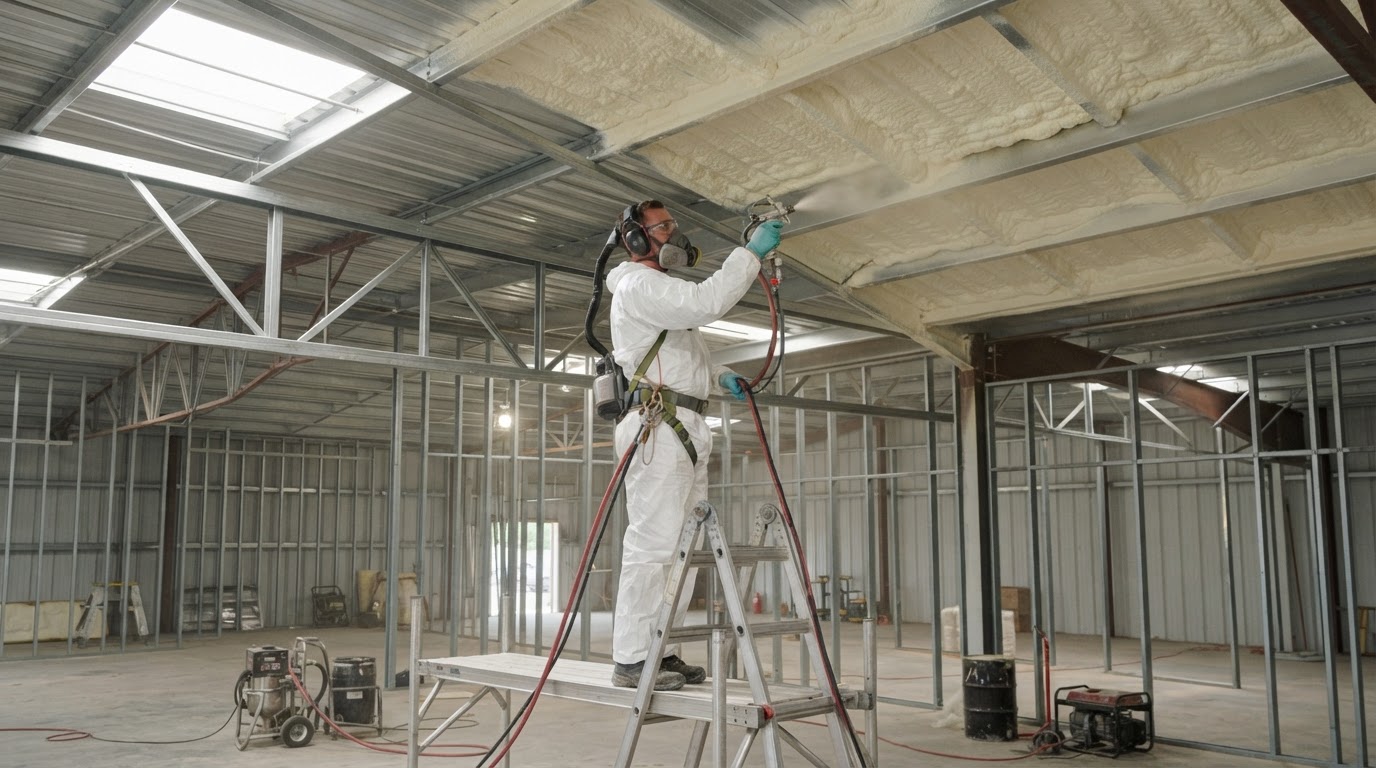
- Often applied directly to metal siding and roofing
- Commonly considered for workshops, pole barns, and commercial metal structures
Often considered for metal-building condensation concerns, but not universally required — selection depends on the assembly.
Not sure which spray foam fits your project?
Call (910) 909-4411Planning Spray Foam for a Condensation-Prone Metal Building Near Wilmington
Planning spray foam for a condensation-prone metal building starts with understanding building use and identifying where moisture actually appears. Distinguishing condensation from obvious leaks is an important early step, because spray foam is not a repair for roof or plumbing leaks. We do not provide engineering, roofing, HVAC, mold remediation, or moisture-remediation services.
1. Understand Building Use
We review how the metal building is used, whether it is conditioned, and what conditions are observed.
2. Identify Where Moisture Appears
We discuss where condensation or moisture is being noticed and under what conditions.
3. Distinguish Condensation From Leaks
We help distinguish surface condensation from obvious roof or plumbing leaks, which must be addressed separately.
4. Evaluate Metal Surfaces
Metal surfaces, framing, and substrate condition are evaluated before any recommendation.
5. Consider Interior Humidity
Interior humidity, ventilation, and building use are considered as part of the overall strategy.
6. Foam Strategy, Preparation & Installation
An appropriate foam and application strategy is chosen, surfaces are prepared, and foam is installed where appropriate.
7. Final Review
Completed work and applicable project details are reviewed with the property owner.
Related Spray Foam Services
Want to talk it through first?
Metal Building Condensation Control Spray Foam FAQs
Dealing With Condensation Concerns in a Wilmington-Area Metal Building?
If you are dealing with condensation concerns in a metal building, workshop, or pole barn, we can help you think through whether spray foam fits your overall building-envelope strategy. Property owners and builders are welcome to discuss their project.