Attic Spray Foam Insulation in Wilmington, NC
Roof deck and roofline spray foam to help reduce attic heat, air leakage, and thermal-envelope gaps in Wilmington homes — for new construction and existing attics.
How Spray Foam Attic Insulation Works in Wilmington Homes
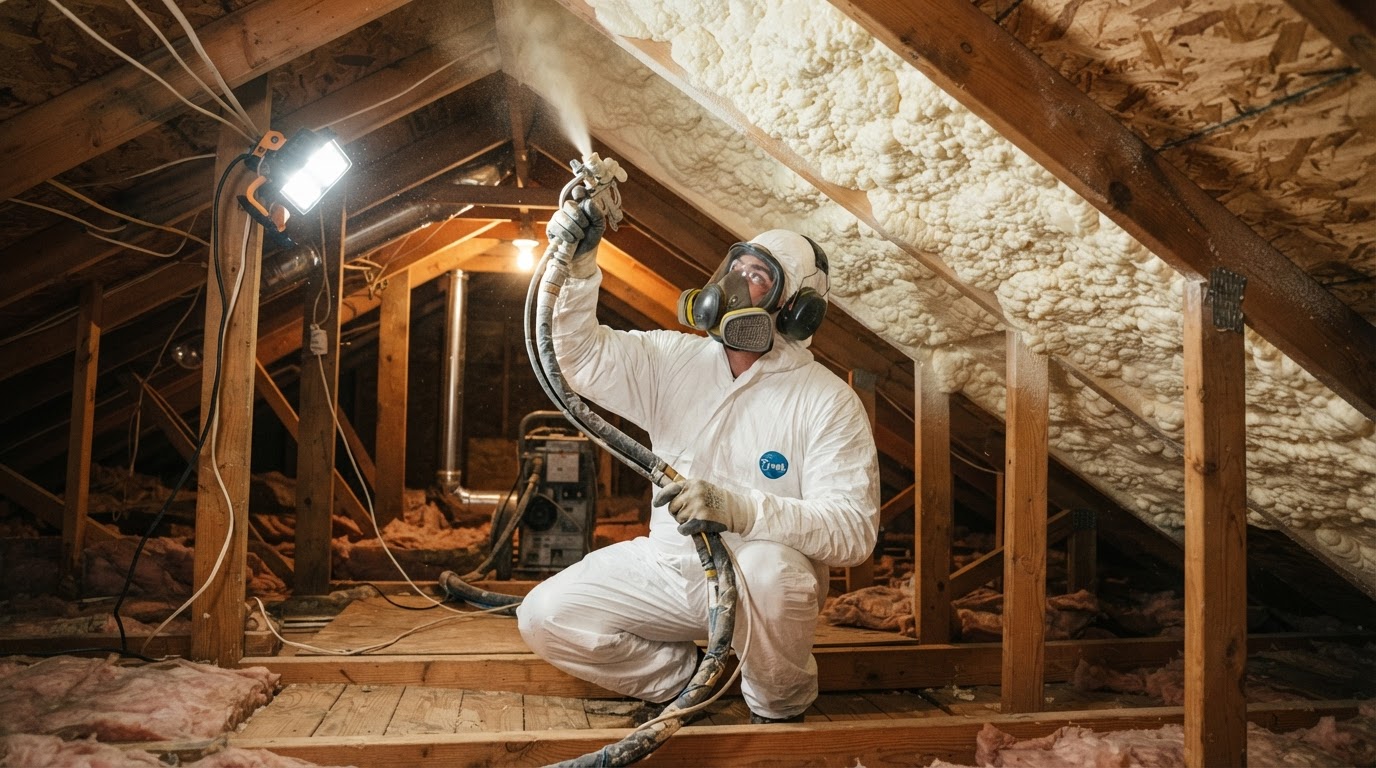
Attic spray foam insulation is the application of spray polyurethane foam to the roof deck, roofline, or attic floor of a residential home. When applied to the underside of the roof deck or along the roofline, the foam expands into rafter bays, gaps, and penetrations to help reduce uncontrolled air movement and create a more continuous thermal boundary at the roof assembly. Wilmington Spray Foam Installation works with homeowners planning attic insulation for new construction and existing homes.
A key concept in attic spray foam is where the thermal boundary is located. Traditional attic insulation often sits at the ceiling plane, leaving the attic itself unconditioned. Roofline spray foam moves the thermal boundary toward the roof assembly, which can bring attic-mounted ductwork and mechanical equipment into the conditioned space depending on the design. Not every attic should automatically be changed from vented to unvented — the building assembly should be evaluated first to determine the appropriate approach.
Attic spray foam is used in both new construction and existing-home retrofits. In new builds, the roofline is fully accessible before finishes are installed. In existing homes, access depends on whether the attic is open and whether existing insulation or finishes need to be addressed first. Product selection — open-cell or closed-cell — depends on the roof assembly, ventilation strategy, vapor-control considerations, and project goals.
Why Wilmington Homeowners Consider Spray Foam for Attics
Attics are a common insulation focus in Wilmington-area homes because hot attic air, air leakage, and roofline gaps can all affect comfort and conditioning. When properly specified and installed, attic spray foam can help reduce uncontrolled air movement and support thermal-envelope continuity — but results depend on the assembly and coverage planned.
Reduced Attic Air Leakage
Foam expands to fill rafter bays, gaps, and penetrations that contribute to uncontrolled air movement through the roof assembly.
Thermal-Envelope Continuity
Roofline applications can help create a more continuous thermal boundary at the roof assembly depending on design.
Mechanical Equipment Coverage
Bringing ductwork and attic-mounted equipment into a conditioned envelope may support conditioning efficiency.
Hard-to-Reach Cavities
Foam conforms to irregular rafter bays and framing transitions that are difficult to insulate with cut products.
Comfort Support
Reduced air leakage and attic heat may help support more stable conditions in rooms below the attic.
Retrofit & New Construction
Attic spray foam can be considered for both accessible existing attics and new construction rooflines.
Where Attic Spray Foam Is Used in Wilmington Homes
Attic spray foam is applied to specific assemblies depending on the roof design and project goals. The applications below are common across Wilmington-area homes, though not every attic uses foam in every area listed.
Roof Decks
Foam applied to the underside of roof sheathing between rafters to insulate at the roof assembly.
Rooflines
Roofline applications that can move the thermal boundary toward the roof, depending on assembly design.
Attic Floors
Where appropriate, foam at the ceiling plane to insulate the boundary between attic and living space.
Knee Walls
Attic knee walls and transitions where air leakage commonly occurs in story-and-a-half homes.
Bonus Rooms
Bonus rooms over garages or within attic spaces where roofline insulation supports comfort.
Cathedral Ceilings
Sloped ceiling and rafter-bay assemblies where cavity depth and roof design influence the approach.
New Construction
Pre-finish application during new builds when the roofline is fully accessible.
Existing Attic Retrofits
Existing homes where accessible attic framing allows insulation upgrades.
What Should Be Evaluated Before Attic Spray Foam
Before attic spray foam is installed, several project-specific factors should be reviewed so the right product and assembly approach are selected. Not every attic should be changed from vented to unvented without evaluation.
- Roof assembly design — vented vs. unvented strategy
- Roof deck and sheathing condition
- Active roof leaks or damaged roofing requiring repair first
- Existing insulation and whether removal or preparation is needed
- HVAC equipment and ductwork location in the attic
- Ventilation and combustion air requirements
- Vapor-control considerations for the chosen assembly
- Access — open attic vs. finished or limited-access spaces
- Open-cell vs. closed-cell suitability for the roof assembly
- Building code and roofing-warranty considerations
Our Attic Spray Foam Installation Process Near Wilmington
An attic spray foam project follows a high-level process that accounts for the roof assembly, existing conditions, and access. The steps below are general — actual sequencing depends on the property and scope.
1. Project Discussion
We review the attic, comfort concerns, roof assembly, and insulation goals for the property.
2. Attic & Roof Evaluation
The roof deck, roofline, existing insulation, and access conditions are evaluated on site.
3. Foam & Application Planning
Open-cell, closed-cell, or another approach is selected based on the roof assembly and objectives.
4. Preparation
Existing insulation is addressed where needed, and the work area is prepared for safe application.
5. Spray Foam Application
Foam is applied to the planned roof deck, roofline, or attic floor assemblies following the agreed scope.
6. Final Review
Completed work and applicable project details are reviewed with the homeowner.
Open-Cell or Closed-Cell Spray Foam for a Wilmington Attic?
Either open-cell or closed-cell foam may be appropriate for an attic depending on the roof assembly, ventilation strategy, vapor-control considerations, and project goals. Neither is universally best — a project-specific evaluation determines the right product for the assembly.
Open-Cell in Attics
- Lower-density foam that expands significantly to fill rafter bays
- Air-sealing function that helps reduce uncontrolled attic air movement
- Common in roofline and roof deck applications where vapor permeance is acceptable
- Sound-dampening characteristics that may benefit occupied bonus rooms
Closed-Cell in Attics
- Higher density and rigidity relative to open-cell
- Lower vapor permeance, considered where vapor control is a priority
- May be appropriate for specific attic assemblies depending on design
- Often evaluated for moisture-sensitive roof assemblies
Attic & Roof Considerations for Wilmington Homes
Attic insulation decisions depend on the roof assembly, mechanical equipment, and existing conditions. The factors below are commonly reviewed when planning attic spray foam in the Wilmington area.
Roof Deck Condition
Sheathing condition and any water damage should be reviewed before foam is applied to the roof deck.
Ventilation Strategy
Whether the attic remains vented or moves toward an unvented conditioned assembly is a key design decision.
HVAC & Ductwork
Attic-mounted equipment and ductwork influence whether bringing the attic into the conditioned envelope makes sense.
Existing Insulation
Older insulation may need removal, repositioning, or evaluation before a roofline spray foam project.
Roof Leaks
Active roof leaks must be addressed before insulation is applied. Spray foam is not a roof repair.
Bonus Rooms & Knee Walls
Story-and-a-half homes, bonus rooms, and knee walls add framing complexity that influences application areas.
Why Professional Attic Spray Foam Installation Matters
Attic spray foam is a professional trade that requires correct material selection, proper equipment, and careful application. Because attics involve roof assemblies and mechanical equipment, professional planning is especially important.
Assembly Evaluation
Determining whether an attic should remain vented or move toward a conditioned assembly requires understanding the roof design.
Correct Product Selection
Choosing open-cell or closed-cell depends on the roof assembly, vapor strategy, and project goals — not a universal product.
Application Consistency
Professional application helps ensure consistent thickness and coverage across rafter bays and roofline transitions.
Surface Preparation
Roof decks and framing must be clean, dry, and suitable for adhesion before foam is applied.
Equipment & PPE
Professional two-component spray foam requires specialized equipment and personal protective equipment during application.
Ventilation During Installation
Proper ventilation and re-entry guidance protect occupants during and after attic application.
Common Reasons to Consider Attic Spray Foam
Homeowners often explore attic spray foam during new construction, renovation, or when addressing comfort and air-leakage concerns. These conditions can be reasons to evaluate the attic insulation system.
- A new home is under construction and the roofline is accessible
- An existing attic is being upgraded during a renovation
- Rooms below the attic are uncomfortable in summer or winter
- Attic-mounted ductwork or HVAC equipment is outside the conditioned envelope
- Existing attic insulation is damaged, deteriorated, or missing
- A bonus room over a garage or within the attic has comfort issues
- A roofline is being redesigned as part of a conditioned attic strategy
- Air leakage at knee walls or roof transitions is a concern
Wilmington Attics & Coastal Climate
Wilmington's hot, humid summers make attics a common comfort and air-leakage focus for local homeowners. Attic air can reach high temperatures, and uncontrolled air movement through roof assemblies and penetrations can affect the rooms below. Attic spray foam can help reduce that air leakage and support thermal-envelope continuity when properly specified and installed.
Because Wilmington is in coastal southeastern North Carolina, moisture and humidity interact with attic assemblies in ways that matter. Insulation, air sealing, roof condition, and ventilation should be considered together — spray foam is one component of an overall attic strategy, not a substitute for roof repair or moisture management. A project-specific evaluation helps determine the right approach for each attic.
Attic Spray Foam Insulation FAQs
Ready to Improve Your Wilmington Attic?
If you are considering attic spray foam for a roof deck, roofline, or retrofit project, we can help evaluate whether it is the right fit for your assembly and goals. Homeowners and builders are welcome to discuss their attic insulation project.