
Agricultural & Farm Building Spray Foam Insulation in Wilmington, NC
Air sealing and thermal-envelope support for farm shops, equipment buildings, barns, and post-frame agricultural structures across the Wilmington area.
Spray Foam Insulation for Farm Buildings Near Wilmington
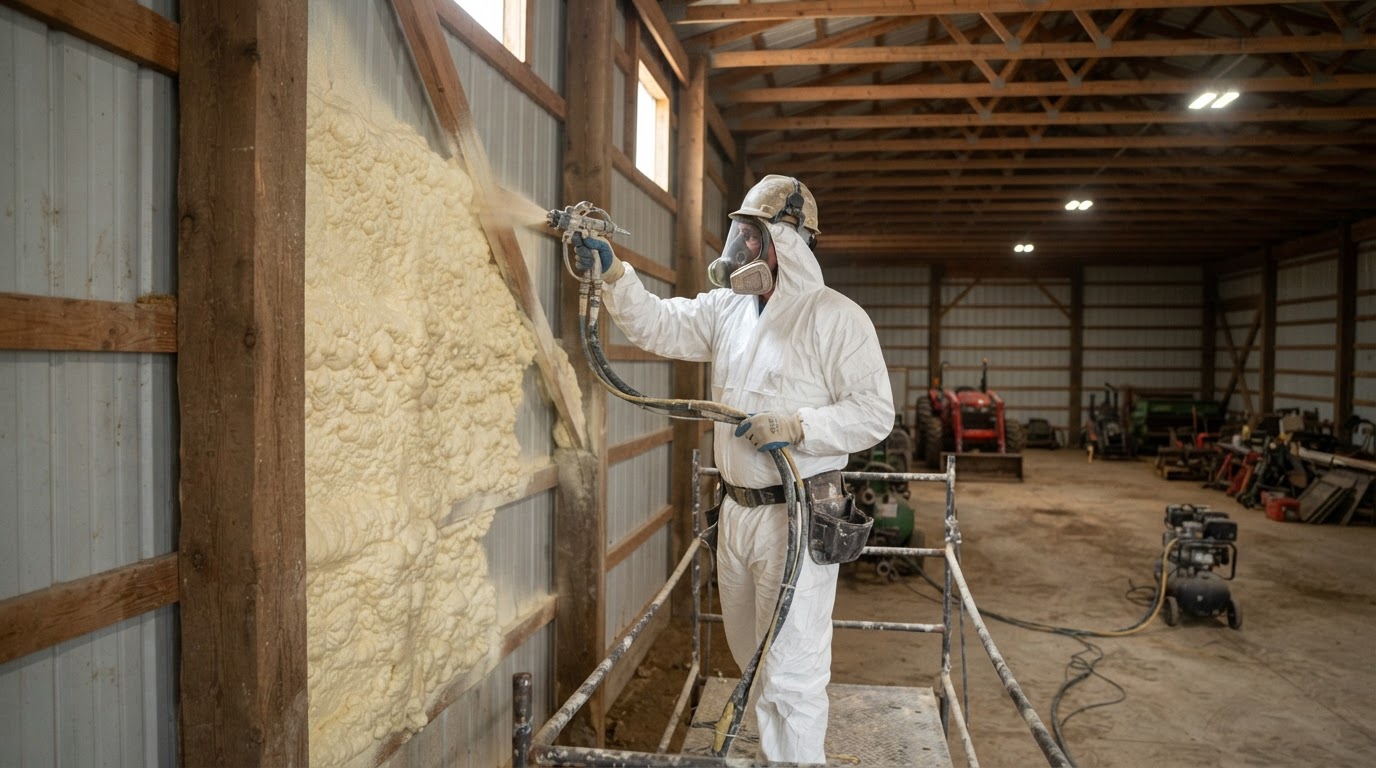
Agricultural and farm building spray foam insulation is applied to the interior walls and roof assemblies of farm structures. The foam is sprayed as a liquid that expands to fill the cavities between posts, conform to metal siding and roofing, and seal gaps that are difficult to insulate with cut batts or board products. The result is insulation combined with air-sealing coverage across the agricultural building envelope.
Every agricultural building has different requirements depending on its use. Equipment storage, animal housing, produce storage, workshops, and occupied spaces each have distinct insulation and air-sealing considerations. Spray foam conforms to the irregular surfaces common in post-frame and metal farm buildings, and both new and existing structures can be candidates depending on access and substrate condition.
Spray foam is one component of a properly planned agricultural building insulation strategy. Building use, ventilation, and assembly design all influence how foam fits into the overall envelope. A project-specific evaluation helps determine the appropriate application areas and product before any work begins.
Benefits of Agricultural Spray Foam for Wilmington Properties
Agricultural buildings in the Wilmington area are used for equipment storage, farm workshops, post-frame structures, metal barns, agricultural garages, utility buildings, storage structures, and farm shops. Spray foam, when properly specified and installed, can help reduce uncontrolled air leakage, support thermal-envelope performance, and provide more manageable interior conditions.
Equipment Storage
Equipment storage buildings benefit from more stable conditions and air sealing.
Farm Workshops
Farm workshops benefit from more consistent temperatures for comfort and usability.
Post-Frame Buildings
Post-frame structures can be insulated with spray foam where the assembly supports it.
Metal Barns
Metal barns are common candidates where condensation and durability are considerations.
Utility Buildings
Utility and storage structures can benefit from improved envelope performance.
Condensation Role
Closed-cell foam may be part of a properly designed condensation-control strategy for metal roofs and walls.
Spray foam does not guarantee prevention of condensation. Condensation depends on ventilation, dew point, assembly design, and building use. Foam can be part of a properly designed condensation-control strategy, but a project-specific evaluation is the right way to plan for metal-surface moisture.
Where Agricultural Spray Foam Is Applied Around Wilmington
Agricultural spray foam is applied to the interior walls and roof assemblies of farm structures. The applications below are common across Wilmington-area agricultural buildings, though not every building uses foam in every area listed.
Equipment Storage Buildings
Interior walls and rooflines are insulated to support more stable storage conditions.
Farm Workshops
Walls and rooflines are insulated to support more consistent working conditions.
Post-Frame Buildings
Spray foam conforms to posts and metal surfaces in post-frame agricultural structures.
Metal Barns
Interior metal walls and roofs are insulated where condensation is a consideration.
Agricultural Garages
Garage-style agricultural structures are insulated for vehicle and equipment storage.
Utility Buildings
Utility and storage structures are insulated where envelope performance matters.
What Should Be Evaluated Before Agricultural Spray Foam
Agricultural buildings combine metal surfaces, post-frame construction, and varied building uses. Before spray foam is installed, several project-specific factors should be reviewed so the right product is applied to the right assembly.
- Building use — equipment storage, workshop, animal housing, produce storage, occupied space
- Wall and roof assembly design and materials
- Metal surface condition and any corrosion requiring repair first
- Existing insulation and whether removal or preparation is needed
- Roof condition and any active leaks requiring repair first
- Interior contents, access, and equipment location
- Ventilation and building-use requirements
- Condensation history and moisture conditions
- Interior finish requirements and applicable code considerations
- Open-cell vs. closed-cell suitability for each assembly
Farm Building Spray Foam Installation Near Wilmington
A farm building spray foam project accounts for building use, existing substrate conditions, and interior contents. Because agricultural buildings often house equipment, vehicles, or supplies, access and preparation are planned carefully before application begins.
1. Building Use Discussion
We review the farm building, its use, and the wall and roof assemblies being considered for insulation.
2. Structure Review
The structure, application areas, and substrate conditions are evaluated on site before any recommendation.
3. Access & Substrate Conditions
Interior contents, access, metal surface condition, and any moisture signs are evaluated.
4. Foam & Application Planning
Open-cell, closed-cell, or another appropriate approach is considered based on the assembly and objectives.
5. Preparation & Installation
The work area is prepared and spray foam is applied to the planned wall and roof assemblies.
6. Final Review
Completed work and applicable project details are reviewed with the property owner.
Open-Cell vs. Closed-Cell Spray Foam for Wilmington Farm Buildings
Many metal agricultural projects may consider closed-cell foam because of its rigidity and lower vapor permeance relative to open-cell, but actual selection depends on the building use and assembly. The right choice depends on the metal surfaces, interior framing, budget, building use, and assembly design. Both products can have a role depending on the project.
Open-Cell in Farm Buildings
- Lower-density foam that expands to fill irregular cavities
- Air-sealing function that can help reduce uncontrolled air leakage
- May be considered for interior framed areas where a vapor barrier is not the primary objective
- Often a lower-cost option depending on the project scope
Closed-Cell in Farm Buildings
- Higher density and rigidity relative to open-cell
- Lower vapor permeance, useful on metal roofs and walls where condensation is a concern
- Often applied directly to metal siding and roofing
- Commonly considered for equipment buildings, farm shops, and metal barns
Agricultural Building Considerations in Wilmington, NC
Agricultural structures combine metal surfaces, post-frame construction, and varied building uses. The factors below are commonly reviewed when planning agricultural spray foam in the Wilmington area.
Building Use
Equipment storage, workshops, animal housing, and occupied spaces each have distinct insulation and air-sealing considerations.
Metal Surface Condition
Metal walls and roofs are evaluated for corrosion, damage, or active leaks before foam is applied.
Condensation Concerns
Metal-surface condensation is evaluated as part of the overall building-envelope and ventilation strategy.
Existing Insulation
Existing insulation is evaluated for condition and whether removal or preparation is needed before foam is applied.
Roof Condition
Active roof leaks or damaged roofing should be addressed before insulation is applied. Spray foam is not a roof repair.
Ventilation
Building-use ventilation requirements interact with the insulated envelope and should be considered together.
Why Professional Agricultural Spray Foam Installation Matters
Spray foam installation is a professional trade that requires correct material selection, proper equipment, and careful application. Agricultural projects add metal-surface and building-use complexity that makes professional evaluation especially important.
Correct Material Selection
Choosing the right foam for each agricultural assembly depends on substrate, building use, and performance goals — not a one-size-fits-all product.
Application Consistency
Professional application helps ensure consistent thickness and coverage across large wall and roof areas.
Surface Preparation
Metal substrates must be clean, dry, and suitable for adhesion before foam is applied, particularly on agricultural buildings.
Equipment & PPE
Professional two-component spray foam requires specialized equipment and personal protective equipment during application.
Ventilation During Installation
Proper ventilation and occupancy planning protect the building and any contents during and after application.
Building-Use Awareness
Understanding how insulation, air sealing, and ventilation interact is essential for agricultural buildings with varied uses.
Common Reasons to Consider Agricultural Spray Foam
Farm owners and agricultural property owners often explore spray foam during new construction, renovation, or when addressing building-envelope concerns. These conditions can be reasons to evaluate the insulation system.
- A new farm shop or equipment building is under construction with open framing
- An existing agricultural building is being renovated with exposed assemblies
- A metal barn experiences condensation on interior roof or wall surfaces
- An equipment storage building has temperature swings or air leakage
- A post-frame structure is being built and insulation coordination is needed
- Existing insulation is damaged, deteriorated, or missing in key assemblies
- A farm workshop is being converted to conditioned use
- A utility or storage building is being upgraded for better envelope performance
Related Agricultural Spray Foam Services
Serving Wilmington & Southeastern North Carolina Farm Owners
Wilmington Spray Foam Installation serves farm owners and agricultural property owners planning spray foam insulation across Wilmington and surrounding southeastern North Carolina communities. From farm shops and equipment buildings to metal barns and post-frame structures, agricultural projects are planned around each building's use, assembly, and conditioning goals.
Wilmington's hot, humid summers and coastal conditions mean air leakage, humidity, and condensation can interact with agricultural building envelopes in ways that matter for equipment, usability, and comfort. Spray foam can help reduce uncontrolled air movement, but insulation, air sealing, ventilation, and moisture management should be considered as parts of the overall building system. A project-specific evaluation helps determine the right approach for each agricultural building.
Agricultural & Farm Building Spray Foam Insulation FAQs
Need Spray Foam for a Farm or Agricultural Building?
Whether you are insulating a farm shop, an equipment building, a metal barn, or a post-frame structure, we can help plan the right spray foam approach. Farm owners and agricultural property owners are welcome to discuss their building.